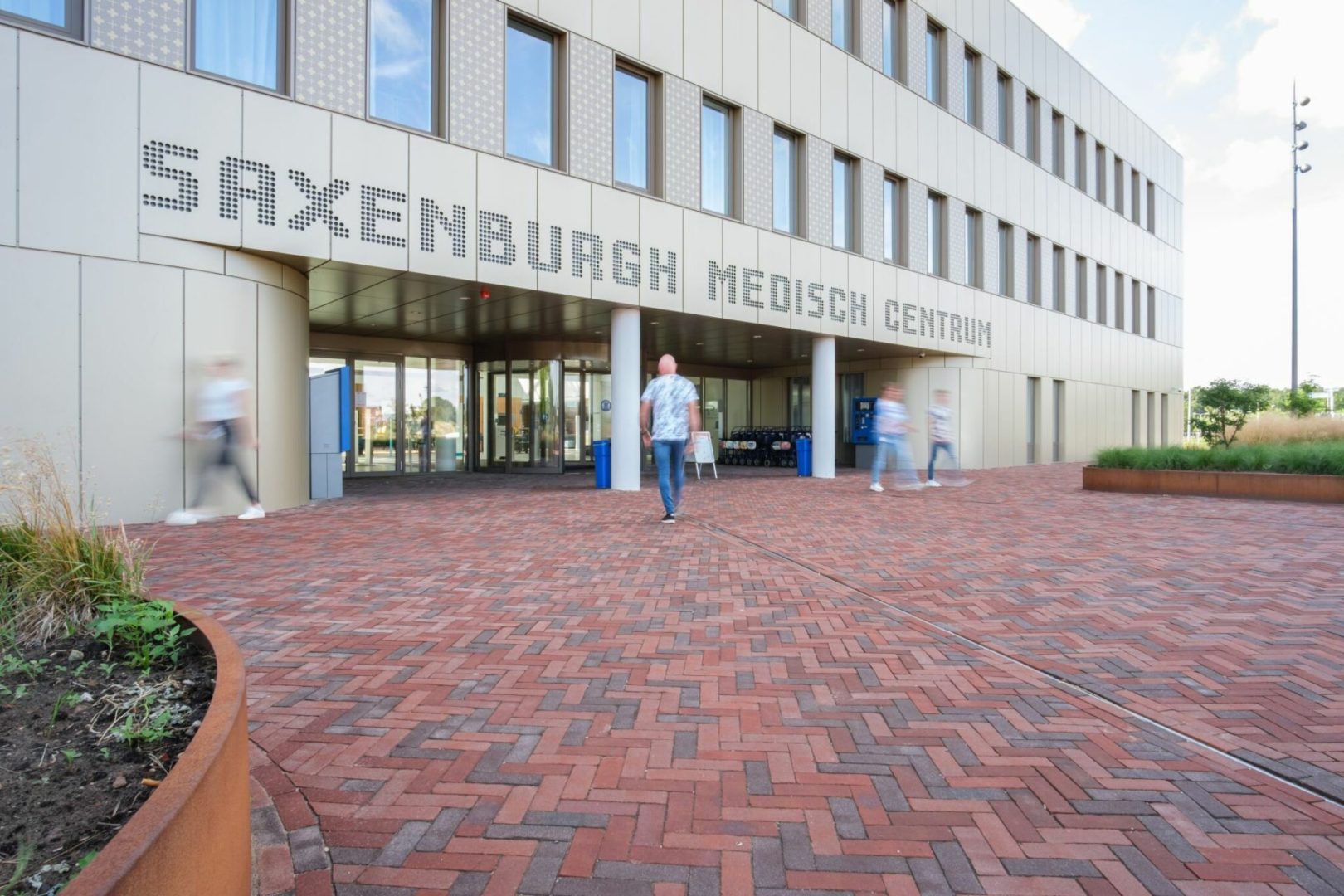

How we gave the IT team at Saxenburgh Medical Center the room to look ahead.
Saxenburgh Medical Center supports a full care chain for four municipalities in Overijssel and Drenthe. More than 2,500 employees across twenty locations rely every day on IT that simply works. The internal IT team led by IT manager Nico Lautenbach is growing along with that responsibility, but its capacity for repetitive management work and 24/7 support had reached its limits.
Industrie
Hospitals and healthcare
Regio
~20 care locations in Coevorden, Hardenberg, Ommen, and Twenterand
Platformen
Oplossingen

Saxenburgh Medical Center serves four municipalities in Overijssel and Drenthe. Hospital care, elderly care, home care, rehabilitation: the organization is woven into the daily life of the region. More than 2,500 employees work across some twenty locations. Every one of them relies on systems that simply work. Not almost always. Always.
That responsibility rests with an IT team of 22 people, led by IT manager Nico Lautenbach. He has worked at Saxenburgh since 2002, when the team was still just five people. He has lived through the entire shift: from IT as a support function to IT as the backbone of care itself.
Fewer people, more care
The challenge Saxenburgh faces isn’t only technical. An aging population is driving a growing demand for care, while the workforce isn’t growing at the same pace. Saxenburgh has to deliver more care with the same people. Working smarter, working more digitally, with processes that run more smoothly.
IT plays a central role in that. But that only works if the IT team itself has the room to look ahead. And there was too little of that room.
More than 200 servers, a large share of them virtual, needed patching every month. Necessary maintenance, but time-consuming and not much of a challenge. The people doing this work were exactly the people Saxenburgh needed for more complex questions. For integrating new care systems, for digitizing processes, for preparing for what’s still to come.
Outside office hours, there was a different problem. A hospital doesn’t close at five. Nurses work night shifts. Doctors are on call at three in the morning. So is IT. But an internal team of normal size can’t cover that on its own.
An extension of the team
co-one came into the picture through Nutanix, a strategic partner that knew our team’s experience in the healthcare sector. That experience was decisive: Saxenburgh wasn’t looking for a supplier, but for someone who understands the care environment and can work as an extension of the team.
We started by taking over patch management. Month after month, structured and without noise. It sounds simple. For the internal team, it felt like a weight lifted off their shoulders.
Next came 24/7 second-line support. Not as someone on standby at the phone, but as a team that steps in when needed and knows what the Saxenburgh environment looks like. In the evening, on the weekend, in the middle of the night: the line is open and there’s always someone who knows the system.
From that foundation, the partnership grew. We helped roll out multi-factor authentication in Microsoft Exchange, a step that strengthened access security across the whole organization. And we implemented SentinelOne on the endpoints: active protection on every workstation, every tablet, every device that connects to the Saxenburgh environment.
No projects that were delivered and closed off. Improvements that were thought through and carried out together with the internal team.
Room for what matters
The servers get patched. The support is in place. The endpoints are secured. Saxenburgh’s internal IT team doesn’t have to worry about any of it. They focus on digitizing care processes, on supporting employees, on the systems that will be needed in a care environment that only keeps getting more complex.