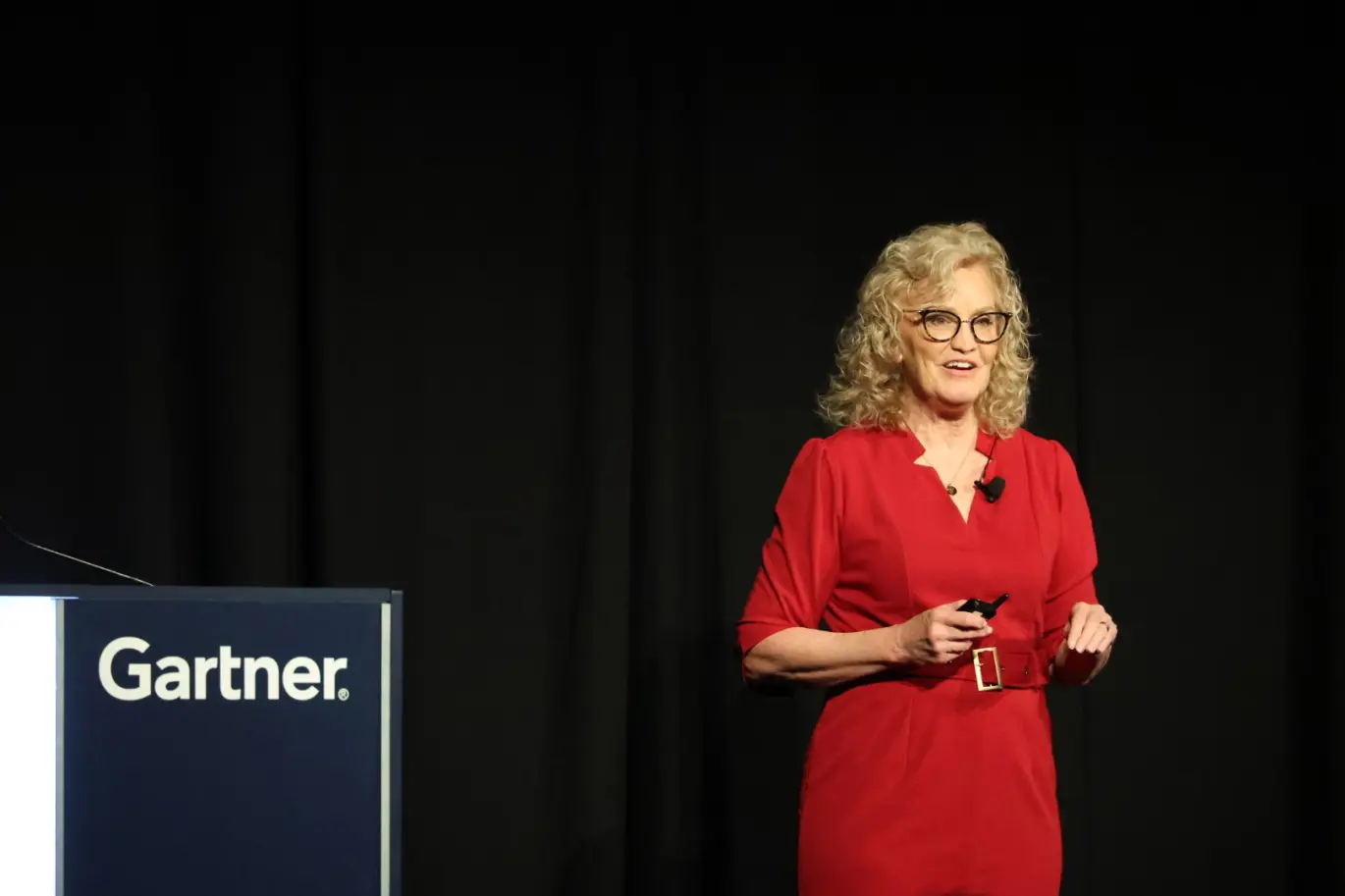

At its Data & Analytics Summit in June 2026, Gartner identified six top trends for data and analytics, with one central message: more than one in ten organizations will be AI-first by 2030. These trends bear directly on how organizations set up their infrastructure, data flows, and AI governance right now. This article lines up the six trends against the co-one practice and answers the question of what they concretely ask of your IT environment.
Trend 1: Sovereign AI accelerates
Countries are investing heavily in their own AI capacity: their own models, their own compute infrastructure, their own data. They want control and are willing to use laws and regulations to protect it. Gartner calls this an external geopolitical reality that organizations need to factor into their AI roadmap today.
For Dutch organizations, this means concrete choices about where data sits, who has access to it, and which suppliers you can and can’t trust. Workloads on infrastructure outside Europe are increasingly coming under pressure: from procurement requirements, from compliance demands, from customers asking questions about it.
In our Hybrid Cloud & Workload Placement services, that’s the ongoing search: the right workload in the right place, with the room to make a different choice tomorrow than you did today.
Trend 2: Managing the risks of AI agents through governance
AI agents are taking over more and more decisions. Strategic, tactical, operational. As long as those decisions can’t be demonstrably traced or accounted for, the risk grows: legally, operationally, and for your reputation. Gartner predicts that decisions that are explicitly captured and modeled will, by 2029, be five times more reliable and made eighty percent faster than decisions that aren’t.
Governance makes sure automated decisions are explainable, auditable, and demonstrably in line with policy.
What we see in practice: the technology is available, the willingness is there, but the framework is missing. Without that foundation, you’re building on quicksand. Our AI Governance services are about exactly that: clear controls, transparent decision-making, and the room to move quickly without taking on unacceptable risks.
Trend 3: Vertrouwen opbouwen met AI governance-platforms
The usual ways of safeguarding quality and reliability no longer suffice. AI regulation is growing more complex worldwide, new risks emerge faster than policy can keep up with them, and autonomous agents are taking over more tasks. AI governance platforms help organizations stay in control: central oversight, workable risk-management frameworks, and enforceable agreements about how AI is used.
Gartner advises organizations to put these platforms in place now. Not as a checklist, but as a working foundation for organizations that want to use AI structurally without losing control.
Trend 4: Data streaming as the basis for real-time intelligence
Batch processing is too slow for organizations that want to work seriously with AI agents. An agent making decisions based on yesterday’s data makes the wrong decisions. Data streaming, where data is available continuously and on an event basis, enables AI agents to respond faster and more accurately. Gartner expects that more than sixty percent of organizations will use this for AI applications by 2028. In 2025, that figure was still below fifteen percent.
The move from batch to streaming calls for a reassessment of the existing data architecture. Not everything has to happen at once, but the course has to be set now.
Trend 5: AI in data management streamlines operations
AI agents are being deployed to make data management more agile: they recognize patterns, offer recommendations, and carry out real-time actions in processes that were previously handled manually. Gartner refers to this as agentic data management and sees it as the answer to the growing complexity of managing large, distributed data environments.
The point of attention is oversight. Self-learning systems drift if you don’t actively monitor them. Without real-time insight into what these agents are doing, when they deviate, and why, you lose your grip on your own environment.
Observability provides that insight: a complete picture of what’s happening in your IT environment, with signals that catch problems before they reach operations. You can only manage what you can see.
Trend 6: GraphRAG for complex AI challenges
Many AI applications get stuck on questions that require nuance, where the relationship between pieces of information matters just as much as the information itself. Traditional RAG techniques, where a language model retrieves relevant documents to formulate an answer, fall short in those cases. GraphRAG combines knowledge graphs with language models, delivering more accurate answers to complex, context-rich questions. Gartner expects that forty percent of organizations will adopt this approach by 2029.
For sectors like healthcare and finance, where factual accuracy and traceability aren’t negotiable, this is a development worth building into your AI strategy now.
What ties the six trends together?
They all point in the same direction: AI is becoming operationally mature, and mature AI calls for a foundation that most organizations don’t yet have.
That foundation consists of three layers.
Data flow and architecture. Real-time, event-driven data streams as a precondition for AI agents that function correctly. Without this, agents are stowaways in your organization.
Governance and control. Explainable decisions, auditable AI, policy that moves with regulation. Without this, adopting AI is a risk rather than an advantage.
Infrastructure with freedom of choice. Workloads in the right place, with the flexibility to choose differently tomorrow than today. Without this, you get boxed in by sovereign AI requirements or vendor lock-in.
At co-one, we work on all three. Not as separate projects, but as connected domains that reinforce one another: Observability, AI Governance, and Hybrid Cloud & Workload Placement.
Want to know where your organization stands?
The six Gartner trends describe decisions organizations are making right now, or failing to make. We’re happy to think through what this means for your IT strategy. Get in touch and we’ll set up a conversation.
Source: Gartner Newsroom, “Gartner Identifies the Top Trends for Data and Analytics,” June 16, 2026. The insights in this article are based on publicly available Gartner publications and given co-one’s own interpretation.


